O-Level Pure Chemistry Tuition Singapore
A1 Chemistry provides specialized Pure Chemistry tuition for Sec 3 & Sec 4 students. We rebuild weak foundations, strengthen answering techniques, and train students to handle application-based 6092 exam questions with confidence.
O-Level Pure Chemistry (6092) is one of the most demanding O-Level subjects in Singapore. Beyond memorization, students must apply concepts to unfamiliar data-based and structured questions under exam pressure.
Who This Programme Is Designed For
Success in O-Level Pure Chemistry requires synthesis, contextualization and application — not just content recall. Our curriculum is structured for:
Students stuck at F9–C5
Students studying consistently but unable to break through to a B3/B4 due to root conceptual gaps that compound over time.
The "Memorizers"
Students who memorise notes but freeze when faced with unfamiliar data-based questions that require application, not recall.
Students stuck at B4–B3
Students who understand the concepts but consistently lose marks due to imprecise scientific phrasing that does not satisfy the marking scheme.
Those aiming for Distinction
High-achievers looking to master higher-order synthesis questions and secure a stable A1 against a competitive national cohort.
The 6092 Paper Structure — What Your Child Is Actually Sitting
The O-Level Pure Chemistry (6092) syllabus consists of three compulsory papers, each testing different skills. Understanding the weighting and demands of each paper is essential for effective preparation.
40 compulsory MCQ items. Tests knowledge and understanding across the full syllabus. A Periodic Table is provided.
Section A (70 marks): compulsory structured questions including a data-based question worth 8–12 marks. Section B (10 marks): answer one of two free-response questions. Highest weighting of all three papers.
Compulsory practical questions assessing Planning (P) — 15% of Paper 3 marks — and Manipulation, Measurement & Observation (MMO), Presentation of Data (PDO), and Analysis, Conclusions & Evaluation (ACE) — 85% of Paper 3 marks. Notes for Qualitative Analysis provided.
Key implication for tuition: Paper 2 carries 50% of total marks and includes a compulsory data-based question worth 8–12 marks. Students who can only recall content, but not apply it to unfamiliar experimental data, will consistently lose marks on this question regardless of how well they perform elsewhere.
Topics Covered In O-Level Pure Chemistry (6092)
Our curriculum is fully aligned to the latest Singapore-Cambridge 6092 syllabus and systematically covers every major topic tested across Paper 1, Paper 2, and Paper 3.
Experimental Chemistry
The Particulate Nature of Matter
Chemical Bonding & Structure
Chemical Calculations
Acid-Base Chemistry
Qualitative Analysis
Redox Chemistry
Patterns in the Periodic Table
Chemical Energetics
Rate of Reactions
Organic Chemistry
Maintaining Air Quality
What makes Pure Chemistry difficult?
O-Level Pure Chemistry requires students to connect concepts across multiple topics simultaneously. For example, Redox Chemistry depends heavily on prior understanding of Acid-Base Chemistry, which in turn relies on solid foundations in Chemical Bonding and Chemical Calculations. The syllabus is designed to test a student's ability to synthesize information across topics — not just recall isolated facts.
Why Memorization Stops Working In Upper Secondary
Many parents are understandably concerned when a student who excelled in Lower Secondary Science suddenly begins struggling in Pure Chemistry. Well, it is common — and it is does not necessarily indicate a lack of effort or ability.
This happens because Lower Secondary Science and O-Level Pure Chemistry test very different cognitive skills. Lower Secondary Science rewards information recall and basic familiarity. The 6092 syllabus, particularly Paper 2 and Paper 3, heavily evaluates a student's ability to handle information, apply concepts, and solve unfamiliar problems.
Three Common Flaws in Chemistry Revision
Passive Revision
Highlighting notes and rereading content feel productive, but they do not train retrieval or application. Students improve when they actively solve unfamiliar questions.
Using Practice Papers Ineffectively
Recognizing an answer is not the same as constructing one. Students must analyze why they lost marks and how the marking scheme awards them.
Memorizing Without Understanding
Many students memorize definitions without understanding the underlying principles. This becomes a major problem in application-based Paper 2 questions.
The Compounding Nature Of The 6092 Syllabus
O-Level Pure Chemistry is highly cumulative. Weak Sec 3 foundations often snowball into major difficulties in Sec 4 topics like Electrochemistry and Organic Chemistry.
1. Weak Chemical Bonding Foundations
If a student does not intuitively understand ionic and covalent bonding, they cannot accurately construct chemical formulas or write balanced equations. Equation writing is the foundational language of Pure Chemistry — every subsequent topic depends on it.
2. The Acids, Bases, Salts & Mole Concept Roadblock
Without balanced equations, students struggle with Acids and Bases — which relies on equation writing to deduce reaction products. Mole Concept follows the same dependency. Students resort to guessing formulas, losing critical marks in calculation questions that appear in both Paper 2 and Paper 3.
Read: Why students lose marks in mole calculations →3. Why Sec 4 Topics Feel Overwhelming
Without firm foundations in Chemical Bonding, Acids & Bases, and Mole Concept, the Sec 4 topics like Redox, Electrochemistry, Rate of Reaction, and Organic Chemistry feel abstract and disconnected. The student is forced to memorize isolated facts rather than applying core principles, which collapses under the application-based questions of the actual exam.
Common Pitfalls That Cost Valuable Marks
Our curriculum is developed around the specific patterns where marks are most frequently lost in the 6092 paper. We systematically train students to identify and navigate the precise examiner expectations behind each question type.
Aligning With The Marking Scheme
Understanding a concept is not enough. Students must express answers using the precise scientific phrasing required by the Cambridge marking scheme.
Why does carbon dioxide have a low melting point?
"Because the bonds are very weak and it takes very little heat to melt it."
Why it fails: Vague. Does not identify the molecular structure, the type of bonds within the molecule, or the type of forces between molecules. The marking scheme requires all three.
Why does carbon dioxide have a low melting point?
"Carbon dioxide has a simple molecular structure (S). There are strong covalent bonds between the carbon and oxygen atoms (B), but weak intermolecular forces of attraction between carbon dioxide molecules (F), which require little energy to overcome (E)."
Why it scores: The S.B.F.E framework (Structure → Bonds → Forces → Energy) directly satisfies each marking point. This same framework applies to every structure and bonding question in the 6092 syllabus.
Many Pure Chemistry questions follow recurring answer structures across school exams and the TYS. Once students recognize these patterns, they can apply a repeatable framework instead of relying on memorization alone.
Paper 3 Practical — 20% of Your Final Grade
Paper 3 contributes 20% of the final grade and is commonly under-prepared for. We train students in:
- Planning Questions
- Qualitative Analysis (QA)
- Titration and experimental error analysis
- Structured data presentation and observation skills
Inside The 4-Student Class
Lessons are conducted live on Zoom and capped at 4 students to allow real-time phrasing correction and active participation.
Concept Diagnosis
We identify and rebuild weak conceptual foundations before moving into exam application.
Application Training
Students attempt higher-order questions under timed conditions to simulate actual Paper 2 pressure.
Real-Time Correction
We critique phrasing, correct misconceptions instantly, and provide structured summary notes.
Documented Grade Improvements
Our methodology consistently yields results for students willing to engage in the process of rebuilding their foundational knowledge and applying it with precision.
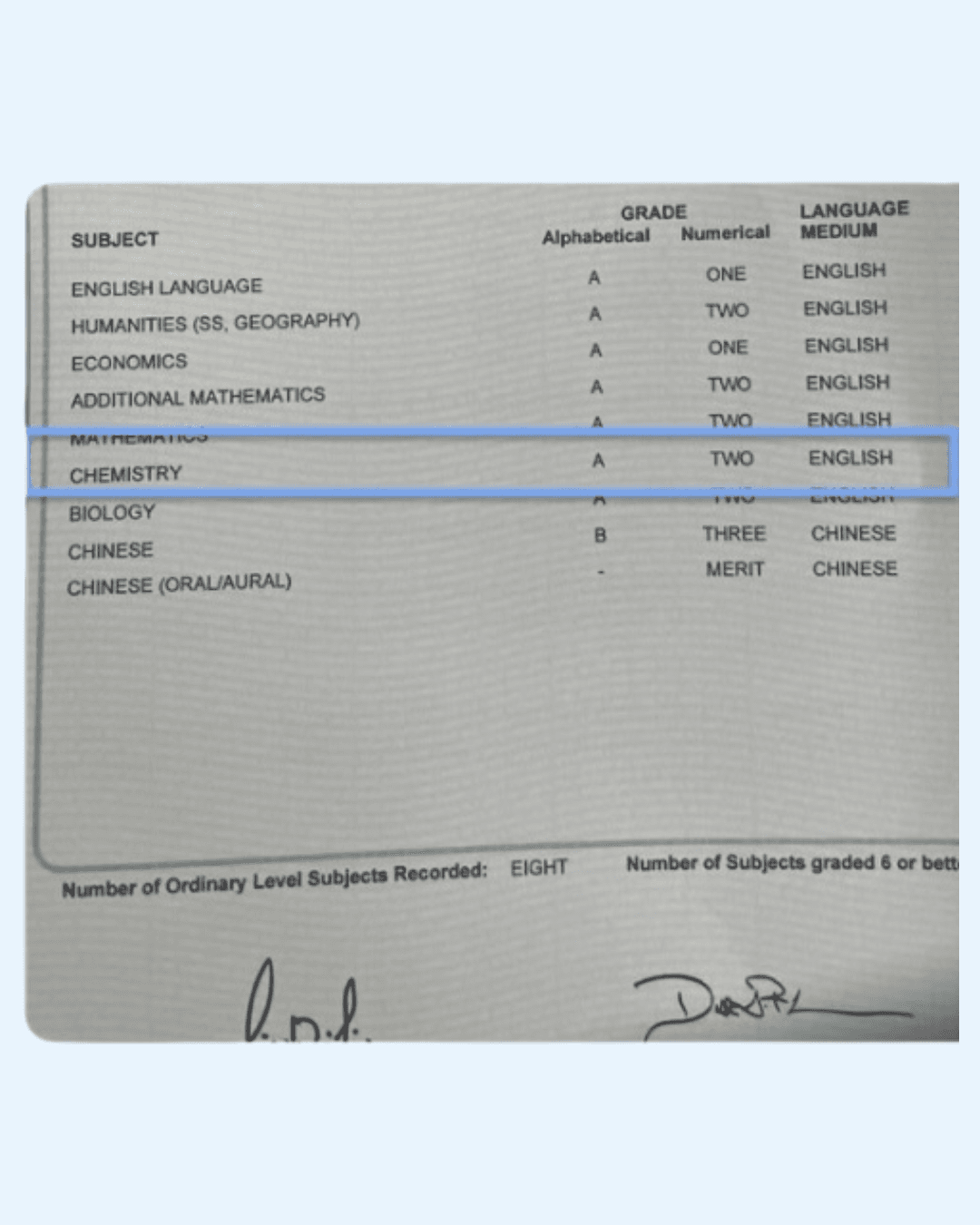
Gavrielle joined A1 Chemistry in April 2025 having essentially given up on Chemistry by Sec 4. She could not follow concepts taught in school and was significantly behind on both Sec 3 and Sec 4 content.
We spent the first four months entirely rebuilding her Sec 3 foundations before moving on to Sec 4 content. From July onwards, Gavrielle practiced relentlessly on exam-style questions and completed the entire Ten-Year Series in under two months. This built both her technique and confidence. Volume is the final stage — but only after the foundations are right.
What To Look For In A Pure Chemistry Tuition Programme
These are the instructional factors that most strongly influence outcomes in O-Level Pure Chemistry.
Are Pure and Combined cohorts strictly separated? The 6092 and 5086/5088 syllabuses require significantly different instructional depth and topic coverage. Combined classes dilute the focus required for Pure Chemistry students.
Does the class size permit individual phrasing correction? Beyond 4–6 students, it becomes logistically difficult for a tutor to thoroughly review and correct each student's specific written answers every lesson.
Is there structured preparation for Paper 3? Paper 3 constitutes 20% of the final grade. Any programme that do not address it is leaving marks on the table.
Does the curriculum address both concept understanding and exam technique? Understanding a concept and scoring marks for it are two different skills. A strong programme teaches both — not just content delivery.
Explore our level-specific Pure Chemistry programmes:
Frequently Asked Questions
Rebuild weak Chemistry foundations before Prelims.
Join our 4-student Pure Chemistry micro-classes designed around the 6092 syllabus, Paper 2 application skills, and marking scheme precision.