O-Level Chemistry is notoriously one of the most difficult subjects for many students in Singapore. Whether you are taking Pure Chemistry (6092) or Combined Science (5086/5088), some students memorize entire chapters but still struggle to score well, while others seem to grasp concepts quickly and consistently excel in their exams.
The truth is that Chemistry is not purely about memorization. Students who score an A1 understand patterns, know exactly how to answer questions the way examiners expect, and revise strategically instead of blindly churning through papers.
This ultimate guide covers the exact study methods, exam techniques, revision strategies, and common mistakes you need to know to work towards an A1. Follow this properly, and that distinction is genuinely within reach.
Table of Contents
- Why Many Students Struggle with O-Level Chemistry
- The Classic QA "Flowchart" Question
- What A1 Students Do Differently (The A1 Method)
- Understanding the Exam Format: Pure (6092) vs Combined Science (5086/5088)
- The Most Important Chemistry Topics to Master
- How to Answer Chemistry Questions Properly
- The Essential O-Level Chemistry Formula List
- How to Study O-Level Chemistry Effectively
- O-Level Chemistry Practical Tips (Paper 3)
- Study Advice Based on Your Current Grade
- Recommended Resources for Chemistry Revision
- Summary: Your A1 Action Plan
Why Many Students Struggle with O-Level Chemistry
Many students falsely believe they are just "bad at Chemistry". In reality, most struggle because of ineffective study methods and weak foundational knowledge. Common reasons for poor performance include:
- Memorizing blindly without understanding the underlying concepts.
- Weak foundations in core topics like the Mole Concept, Chemical Bonding, and Acids & Bases.
- Poor answering techniques and missing the exact keywords required by the mark scheme.
- Passive practice (reading notes) instead of active recall and applying concepts.
- Ignoring corrections after getting questions wrong, leading to repeated mistakes.
- Poor time management during timed examinations.
The Classic QA "Flowchart" Question
To understand why memorization fails, look at the classic O-Level Qualitative Analysis (QA) flowchart question pattern that appears almost every year. This helps to illustrate how Cambridge never tests concepts in isolation.
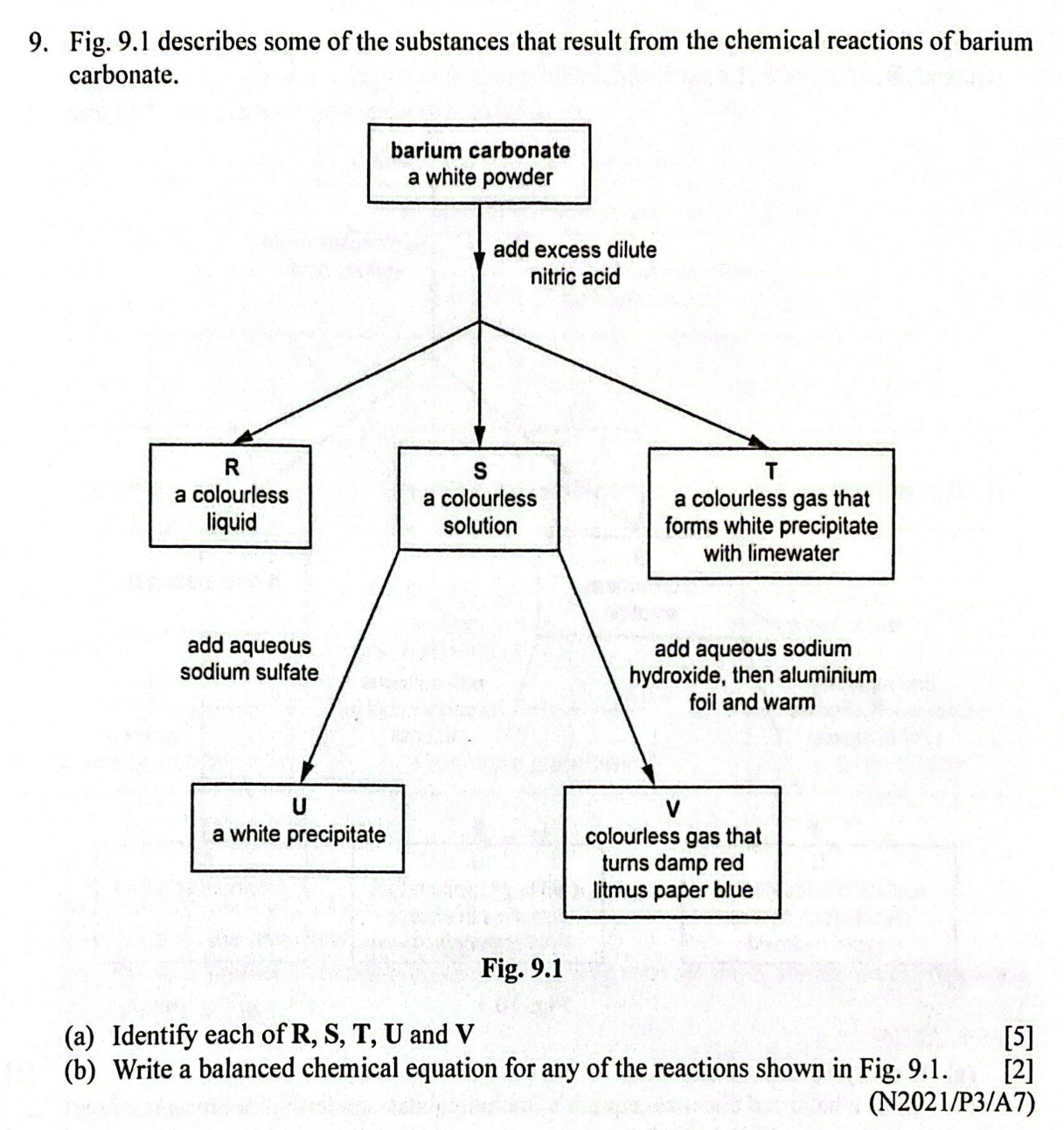
To score full marks here, a student must seamlessly combine 6 different topics:
- Reactivity Series: Knowing that barium nitrate and sodium sulfate will react to give barium sulfate and sodium nitrate in a salt displacement reaction.
- Qualitative Analysis (QA): Knowing that a gas that forms a white ppt in limewater is CO₂, and a gas that turns damp red litmus paper blue is NH₃.
- Acids and Bases: Understanding the general equation of Acid + Carbonate gives salt, water, and CO₂ gas.
- Salts: Familiarity with the solubility table.
- Chemical Equations: Writing and balancing an equation correctly.
- Chemical Bonding: Knowing how to write chemical formulas.
O-Level Chemistry is highly interconnected. Once your foundational topics are weak, the later chapters become a frustrating uphill battle.
What A1 Students Do Differently (The A1 Method)
Students who score distinctions approach Chemistry fundamentally differently from average students. Instead of memorizing entire model answers, strong students learn to "think like markers" — a cornerstone of The A1 Method. Strong Chemistry students habitually:
- Understand explanation structures and answering frameworks.
- Identify question patterns that repeat across different years.
- Target specific mark-scheme keywords.
- Review their error logs consistently.
This targeted approach makes revision significantly more efficient than rereading textbooks.
Understanding the Exam Format: Pure (6092) vs Combined Science (5086/5088)
Before diving into revision, you must understand exactly how the SEAB examination is structured and weighted for your specific syllabus.
Pure Chemistry (Syllabus 6092)
For Pure Science students, Chemistry is a standalone subject with three dedicated papers.
| Paper | Component | Marks | Duration | Weightage |
|---|---|---|---|---|
| Paper 1 | Multiple Choice (MCQ) | 40 | 1 h | 30% |
| Paper 2 | Structured & Free Response | 80 | 1 h 45 min | 50% |
| Paper 3 | Practical Exam | 40 | 1 h 50 min | 20% |
Combined Science Chemistry (Syllabuses 5086 / 5088)
For Combined Science students, Chemistry is merged with either Physics (5086) or Biology (5088) to form a single final grade.
| Paper | Component | Marks | Duration | Subject Weightage |
|---|---|---|---|---|
| Paper 1 | MCQ (Across both sciences) | 40 | 1 h | 20% |
| Paper 3 | Chemistry Structured Questions | 65 | 1 h 15 min | 32.5% |
| Paper 5 | Practical (Across both sciences) | 30 | 1 h 30 min | 15% |
The MCQ Paper (Pure Paper 1 / Combined Paper 1)
This paper tests conceptual understanding, calculation accuracy, speed, and common misconceptions. Careless mistakes here will heavily drag down your overall grade.
- Strategy: Aim for at least 38/40 marks to build a safe buffer. You have roughly 1.5 minutes per question (Combined Science students will tackle 20 Chemistry MCQs alongside 20 from their other science). Recall-based/factual questions should take less than 20 seconds, allowing you to bank time for heavy calculations.
- Tips: Underline keywords, watch out for state symbols, eliminate obvious wrong answers, and never leave blanks.
The Structured Questions (Pure Paper 2 / Combined Paper 3)
Carrying the highest weightage (50% for Pure, 32.5% for Combined), this is the deciding factor for your A1. It tests application, data interpretation, and explanation skills.
- Strategy: Spend 2-3 minutes skimming the paper before writing. Attempt your strongest questions first. Leave 8-10 minutes at the end for checking. Focus heavily on answering techniques, structures and keywords.
- Time Trap: Do not spend 15 minutes on a 3-mark question just because you are stuck. Allocate your time strictly proportional to the marks given. Show full workings for all calculations.
The Practical Exam (Pure Paper 3 / Combined Paper 5)
The practical paper tests experimental skills, observations, graph drawing, and data analysis.
Note: Pure Chemistry students are also tested on independent experimental planning, whereas Combined Science students face slightly simpler setups without the planning strand.
- Strategy: Many students neglect practical preparation until the final weeks, which becomes a major weakness. Some schools may not prepare students adequately for chemistry practicals. However, you do not always need a lab to prepare. Core skills like Presentation of Data and Observations (PDO) and Analysis, Conclusion, and Evaluation (ACE) can be heavily trained through written exercises well in advance.
Recent Exam Trends: Context is Everything. In recent years, Cambridge has shifted away from pure recall and heavily towards application and data analysis. Contextualising your answers to the given data is no longer optional — if a question says "using the data provided," failing to reference specific numbers or trends will cost you the marks, even if the science is correct.
The Most Important Chemistry Topics to Master
Focus your energy by categorizing the syllabus into three types: Core, Templated, and High-Weightage.
1. Core Topics
These lay the foundation. Mess these up, and everything else crumbles.
- Chemical Bonding: Master writing chemical formulas (especially polyatomic ions like OH⁻, NO₃⁻, CO₃²⁻, NH₄⁺, SO₄²⁻) and balanced equations. This is the basic vocabulary of Chemistry.
- Acids, Bases, and Salts: You must memorize the 4 core reactions (acid + metal, acid + base, acid + carbonate, alkali + ammonium salt) and the Solubility Table.
2. Templated Topics
These are easy marks. The questions are asked the same way every year, and the answers always follow a rigid structure/framework.
- Kinetic Particle Theory (Movement and Arrangement of Particles)
- Atomic Structure & Isotopes
- Chemical Bonding (Melting/Boiling Point, Electrical Conductivity, and Dot/Cross Diagrams)
- Redox Chemistry (Explaining Oxidation/Reduction)
- Rate of Reactions (Collision Theory)
An Example: The S.P.F.E Framework for Chemical Bonding
Always use the Structure, Particle Type, Forces of Attraction, Energy (S.P.F.E) framework:
- Simple Molecular (e.g., CO₂): CO₂ has a simple molecular structure (S). There are strong covalent bonds between carbon and oxygen atoms (P), but weak intermolecular forces of attraction between CO₂ molecules (F). Little energy is required to overcome these weak forces (E), resulting in a low boiling point.
- Giant Ionic (e.g., NaCl): NaCl has a giant ionic crystal lattice structure (S). There are strong electrostatic forces of attraction (F) between oppositely charged Na⁺ and Cl⁻ ions (P). A large amount of energy is required to overcome these strong forces (E), resulting in a high boiling point.
- Giant Covalent (e.g., Diamond): Diamond has a giant covalent structure (S). There are strong covalent bonds (F) between the carbon atoms (P) in the tetrahedral structure, that require a lot of energy to overcome (E). Hence, diamond has a high boiling point.
Tired of memorizing model answers? The S.P.F.E framework is exactly how we teach our Sec 3 and Sec 4 students to score full marks for Chemical Bonding questions. If you want to master these techniques in a guided, small-group setting, check out our programmes.
3. High-Weightage Topics
- Mole Concept: Focus on unit conversions, limiting/excess reagents, and formula triangles. Usually tested in both Structured and Practical papers. Download our free Mole Concept Notes.
- Electrolysis (Pure Chemistry): One of the most heavily tested Paper 2 topics. Predict electrode products based on the position of ions in the reactivity series and electrolyte concentration.
- Organic Chemistry: Appears late in the syllabus but carries massive weightage. To secure your Organic Chemistry marks, master organic properties, reactions and this functional group table:
| Homologous Series | Functional Group | General Formula |
|---|---|---|
| Alkanes | None (C-C single bonds) | CₙH₂ₙ₊₂ |
| Alkenes | Carbon-Carbon double bond (C=C) | CₙH₂ₙ |
| Alcohols | Hydroxyl group (-OH) | CₙH₂ₙ₊₁OH |
| Carboxylic Acids | Carboxyl group (-COOH) | CₙH₂ₙ₊₁COOH |
Download our free Organic Chemistry Summary Mindmaps.
- Qualitative Analysis (QA): Usually tested in both Structured and Practical papers, making it one of the most important and high-scoring topics to master. To do well in QA, you need to:
-
Understand why reagents are added. For example,
Test Purpose Acidified Silver Nitrate To identify halides Acidified Barium Nitrate To identify sulfates -
Be good at spotting colours. For example,
Colour Ion Present Pale Green Fe²⁺ Yellow Fe³⁺ Blue Cu²⁺
-
How to Answer Chemistry Questions Properly
1. Understand Command Words
The command word dictates exactly what the examiner is looking for. Pair it together with the marks allocated to gauge what and how much to write.
- State (1m): Provide a concise, direct fact. No explanation is needed.
- Describe (1-2m): State the main points or observations (e.g., "Describe the colour change").
- Explain (2-3m): Provide the scientific reasoning or theory behind an observation.
- Suggest (1-2m): Apply your knowledge to a novel, unfamiliar situation.
- Calculate (1-3m): Perform numerical math. You must show full working and units.
2. Observation vs. Explanation
Do not confuse these two concepts — examiners penalize this heavily.
- An observation is a fact that someone with zero chemistry knowledge can see (e.g., "The blue solution turned colourless").
- An explanation is the scientific reason behind it (e.g., "Cu²⁺ ions were reduced to form solid Cu metal").
Students always mix these 2 up, resulting in marks being deducted.
3. Target Mark-Scheme Keywords
Without specific keywords, explanations get marked down as "vague." Precision matters heavily in Chemistry.
- Weak: "Because there are more particles, so they hit each other more."
- Strong: "There are more reacting particles per unit volume. The frequency of effective collisions increases, leading to a faster rate of reaction."
4. Common Mistakes That Cost You Marks
Some mistakes appear repeatedly across many students. These include:
- Forgetting state symbols (especially in ionic equations where it is mandatory).
- Not balancing equations.
- Missing units or poor presentation of working.
- Careless calculation errors.
- Incomplete explanations.
- Not addressing what the question wants.
- Confusing observations with explanations.
- Not contextualizing, even after the question says "using the data...". This is a surefire way to lose marks.
Students should actively look for these mistakes during revision.
The Essential O-Level Chemistry Formula List
Calculation questions are free marks if you know the formulas. Keep this list visible on your desk whenever you study:
- Mole (from Mass):
- Mole (from Solution): (where volume is in dm³)
- Mole of Gas: (where volume is in dm³)
- Percentage Yield (Pure Chemistry):
- Percentage Purity (Pure Chemistry):
How to Study O-Level Chemistry Effectively
-
Read the SEAB Syllabus: The syllabus document details exactly what Cambridge may test you on. However, most students don't pay much attention to it. Use it as a literal checklist to ensure you have covered all grounds in your revision. At A1 Chemistry, all our materials are mapped directly to this syllabus to ensure zero content gaps.
-
Maintain an Error Log: This is the single biggest differentiator between a B3 and an A1 student. Record every mistake, note why you got it wrong, and write out the perfect model answer. Try to apply the model answer in the next paper, update the error log, rinse and repeat.
-
Active Recall: Close the notes, test yourself, write equations without looking, and use flashcards. For calculation-heavy topics like Mole Concept, create a formula flowchart showing how all the different quantities (mass, moles, volume, concentration, particles) connect to each other. This single flowchart becomes your revision anchor.
-
The Feynman Technique: Try to explain/teach concepts to a friend. If you can't explain it well yourself, you likely have some gaps missing and you know exactly where to focus on.
The Spaced Revision Timeline
- 5-6 Months Before (April-May): Complete topical TYS questions. Do not touch yearly papers yet.
- 3-4 Months Before (June-July): Transition to full Yearly TYS papers under timed conditions. Mark strictly against the scheme. Doing papers under timed conditions allows you to condition yourself to remain calm and think clearly even under time pressure.
- 1 Month Before (September): Yearly TYS should be completed. Focus on school Prelim papers for added difficulty. Drill your error log.
- Final Week: Stop learning new content. Review your summaries and keep your mind sharp.
The 3-Month Late Starter Plan: If you are a late starter, you need to triage. One of the biggest mistakes students make is studying passively (reading and beautifying notes). Drop the yearly papers initially. Heavily drill topical TYS for Mole Concept, Organic Chemistry, and Acids & Bases. Memorise the S.P.F.E frameworks to secure your templated marks, then quickly pivot to timed Paper 2/3s to build exam stamina. Focus strictly on high-yield topics.
O-Level Chemistry Practical Tips (Paper 3)
- Read ahead: Read the entire experiment before starting to avoid duplicate steps or using the wrong solution.
- Master Titration Technique: Always perform one rough titration first to find the approximate endpoint, followed by one accurate titration drop-by-drop. Titration takes a long time to set up; doing it more than twice will leave you with insufficient time to finish the QA section.
- Be precise: Never write "colour changed." Write: "colourless solution turned blue."
- Always test gases: If you see effervescence, perform a gas test and explicitly identify the gas.
- Practise Planning: Know how to identify independent/dependent variables and suggest methods to improve reliability.
- Record observations as you go: Do not wait until the end. Write down exactly what you see at each step.
- Stay organized: Organize your reagents and apparatus properly; a messy table affects your ability to find items and may affect your psyche.
Study Advice Based on Your Current Grade
- If you are failing (E8-F9): Focus entirely on foundational chapters (Chemical Formula writing, Equation balancing, Mole Concept, Acids & Bases) and simple topical questions.
- If you are scoring C5-B4: Focus on answering techniques, consistency, and maintaining your error log. This is where students see the fastest, most dramatic improvements.
- If you are scoring B3-A2: You already know the content. Focus strictly on precision, contextualizing your answers to data, eliminating careless calculation errors, and perfecting time management. Small tweaks here push you to an A1.
Recommended Resources for Chemistry Revision
Looking for the best O-Level Chemistry notes Singapore has to offer? Stop relying on messy school handouts. A1 Chemistry provides condensed O-Level Chemistry summary notes that highlight keywords, command words, and frameworks. Pair these with:
- Topical and Yearly TYS
- HolyGrail Prelim papers
- Flashcards for organic reactions and definitions
- Mindmaps/Summary sheets
- Your personal error log
- Consultation sessions with teachers/tutors
Summary: Your A1 Action Plan
- Understand the exam format and target an 80% aggregate.
- Master the Core, Templated, and High-Weightage topics first.
- Learn command words and answer exactly according to their requirements.
- Show full working in all calculations to eliminate careless mark deductions.
- Memorize mark-scheme keywords and the S.P.F.E frameworks.
- Do topical past papers first, then transition to full timed yearly papers.
- Keep a running error log and review it every single week.
- Prepare seriously for Paper 3 Practical (especially Titration and Planning).
Improvement usually happens gradually, not overnight. Remember the secret to an A1 is Conceptual Clarity + Exam Techniques.